
Article
Why FTP is no longer enough and CP is king
FTP is one number on a good day. Critical Power and W′ model how you actually ride, minute by minute — here's why CP is the better basis for training.

Stride moved beyond a single FTP number by using Critical Power and W′ to model how you actually ride, minute by minute, rather than how you perform in one test on a good day. We did this from the start because this gives a clearer, more responsive picture of your current ability and makes training targets and pacing more precise.
Why FTP is no longer enough
FTP was a brilliant shortcut: one number to describe your “threshold” and set all your zones. But it comes with problems.
- It assumes you can ride at that “hour power” in a steady, controlled way, which is rarely how races or hard group rides unfold.
- It does not tell you how strong you are in short, repeated efforts, sprints out of corners or punchy climbs.
- It is static between tests, even though your fitness and freshness change day to day.
- Different test protocols, motivations and pacing can all skew the result, yet that single number drives everything until you test again.
In other words, FTP is useful, but it only describes a slice of who you are as a rider.
Critical Power in plain language
Critical Power (CP) takes the same basic idea as threshold and makes it more robust by using several hard efforts of different lengths instead of one magic test.
- CP is the highest power you can sustain for a long time while staying in something like a steady state, without blowing up quickly.
- Ride just under CP and you can keep going for a long time; ride above it and fatigue rises rapidly.
- Mathematically, CP comes from the curve that links your best efforts over different durations, typically from a few minutes to around half an hour.
Think of CP as a more grounded, data driven version of threshold that is tied to how you actually perform, not just how you rode one 20 minute test.
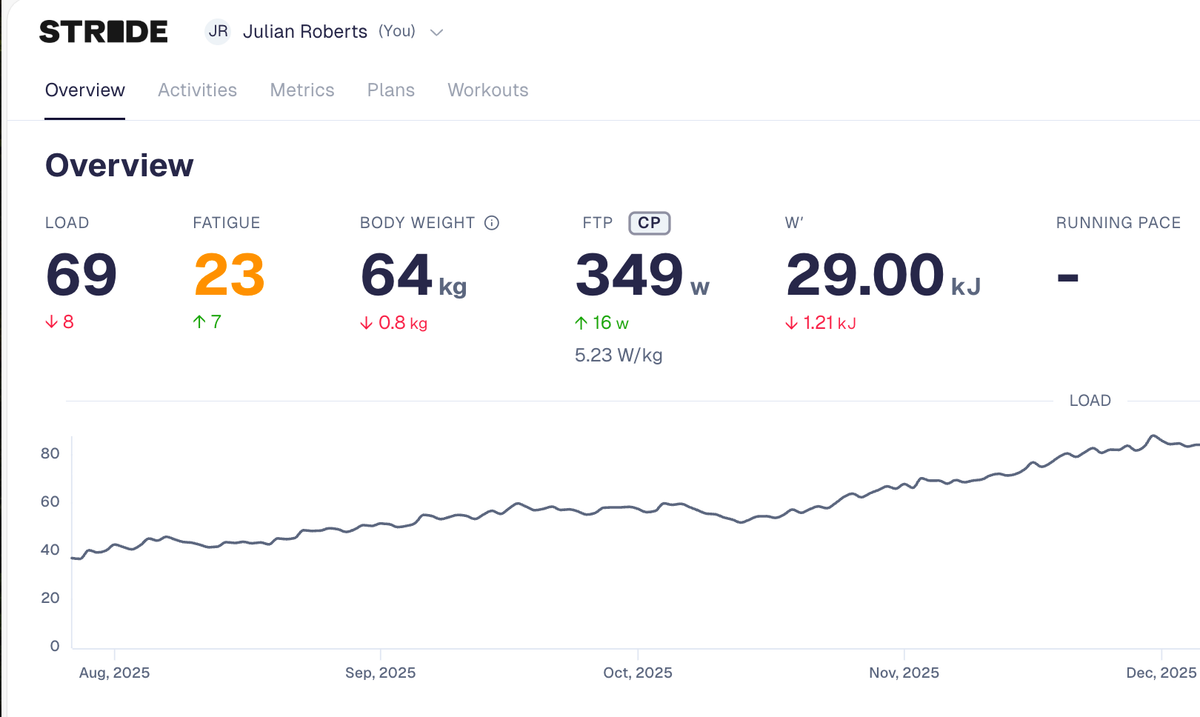
W′: your anaerobic battery
If CP is your “cruise” ability, W′ (W prime) is your battery for hard efforts above that level.
- W′ is measured in kilojoules and represents the total amount of work you can do above CP before you are forced to back off.
- Every surge over CP drains that battery; dropping back under CP allows it to recharge gradually.
- Riders with a big W′ can attack repeatedly, punch over short climbs and sprint hard at the end, even if their CP is similar to someone else.
A simple way to picture it: CP is the speed of the group on a long climb, W′ is how many times you can jump across gaps, chase wheels and still have something left at the top.
Why CP and W′ model “true performance”
The power of CP and W′ is not just in the numbers themselves, but in how they work together as a model of your performance over time.
- The CP–W′ relationship describes a predictable power duration curve: shorter efforts allow higher power, but you always pay from the same W′ battery.
- From that curve, we can estimate what you should be able to do for almost any duration, not just 20 or 60 minutes.
- By tracking how W′ depletes and recovers during a ride (often called W′ balance), we can see when you are close to “empty” and when you genuinely have room to go again.
- This aligns well with how riders and coaches experience racing: a game of limited matches, not one continuous, smooth effort.
Compared with a single FTP value, CP and W′ give a richer, time aware picture of what you can actually do under different demands.
How Stride uses this to move beyond FTP
Stride already estimates FTP, CP and W′ from your training data, but the real step forward is how these feed into planning, analysis and on road decision making.
- Training plans and AI generated workouts can be targeted to improve CP, W′ or both, depending on your goals, power profile and race demands.
- Session difficulty and “Training Score” are informed by how much time you spend near CP and how deeply you dip into W′, rather than just average power versus FTP.
- For hard rides and races, Stride can show how your W′ was spent across climbs, sprints and crosswinds, highlighting where you over paced or left energy unused.
- Because CP and W′ are estimated from your ongoing rides, your model of “current ability” updates as your form changes, instead of waiting for the next formal test.
For athletes, this means more honest targets, smarter pacing and training that reflects how you really ride. Instead of being defined by one FTP number, you are described by a model of your whole performance profile, built to capture both your engine and your matches.
Ready to experience this in your own training?
Start your 30 day free trial with Stride today and see how Critical Power and W′ modelling can unlock your true performance potential: https://www.stride.is.
Frequently asked questions
- What is Critical Power?
- Critical Power (CP) is the highest power you can sustain aerobically for a long time, estimated from efforts of several durations rather than one test. With W′ — your anaerobic reserve — it models how you actually ride minute to minute.
- What's the difference between Critical Power and FTP?
- FTP is usually a single test-based estimate of one-hour power. Critical Power is fitted from multiple efforts and pairs with W′ to describe both your sustainable power and your finite reserve above it — often a more responsive picture.
- Is Critical Power more accurate than FTP?
- For many riders, yes — it's derived from several real efforts and updates as you ride, rather than depending on one maximal test on a good day. Stride models CP and W′ from your normal rides.
- How do you find your Critical Power?
- A CP model is fitted from maximal efforts of a few different durations. Stride does this automatically from your power history, so you don't need a formal test.