
Article
Endurance Training Metrics and Terms, Explained
A plain-English glossary of the endurance training metrics that matter — FTP, Critical Power, W′, Normalized Power, IF, TSS, training load and aerobic decoupling.
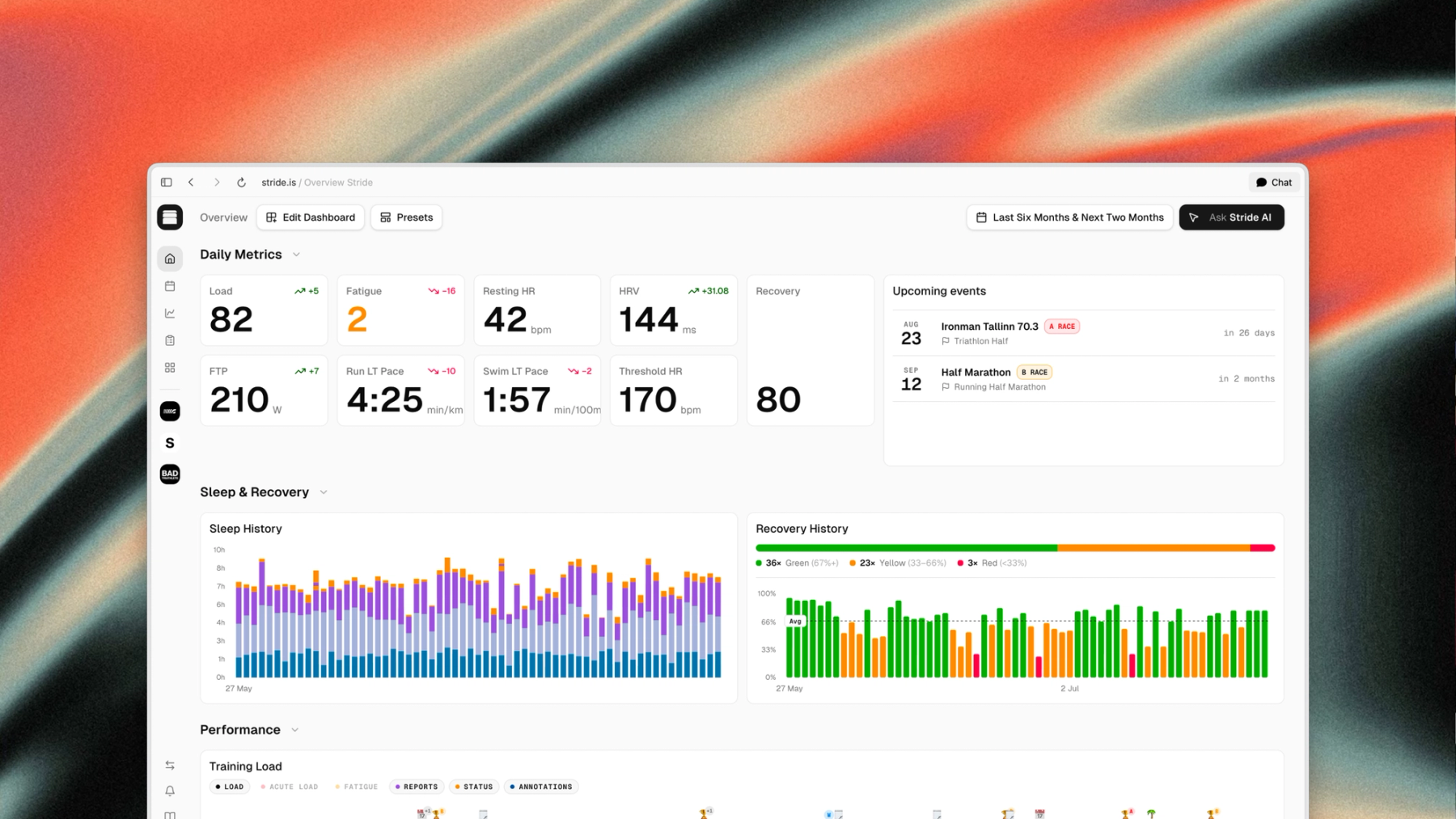
Training data is full of acronyms. This is a plain-English glossary of the metrics that actually matter for endurance athletes — what each one means, and where to go deeper. Stride computes all of these automatically from your rides and runs.
FTP (Functional Threshold Power)
The highest power you can sustain for roughly an hour, and the most common anchor for cycling training zones. How to test your FTP.
Critical Power (CP)
A model-based estimate of your sustainable power, derived from efforts of several durations — often more robust than a single FTP test. Why Critical Power beats FTP.
W′ (W-prime) and W′ balance
W′ is the fixed amount of work you can do above Critical Power — your anaerobic 'battery'. W′ balance tracks how much is left in real time. What is W′ prime and how to read W′ balance.
Normalized Power (NP)
An adjusted average that weights the surges in a ride, reflecting its true physiological cost better than plain average power — a steady ride and a stop-start ride with the same average can have very different Normalized Power.
Intensity Factor (IF)
Your Normalized Power divided by your FTP — a quick read of how hard a session was relative to your threshold. An easy ride might be 0.65; a hard race effort 0.85 or more.
TSS (Training Stress Score)
A single number combining how long and how hard a session was, so you can compare the load of very different workouts. An hour at threshold is, by definition, about 100 TSS.
Training load: CTL, ATL and TSB
CTL (fitness) is your long-term average load, ATL (fatigue) your short-term load, and TSB (form) the difference between them — together they show whether you're building, holding or freshening up.
Aerobic decoupling
The drift in your power-to-heart-rate ratio over a long effort — a low figure means strong aerobic endurance, a high one signals you're not yet durable. Related: the durability problem.
Want all of these computed for you, automatically? Try Stride free.
Frequently asked questions
- What is FTP in cycling?
- Functional Threshold Power is the highest power you can sustain for about an hour. It's the standard anchor for cycling training zones.
- What's the difference between FTP and Critical Power?
- FTP is usually a single test-based number for roughly one hour; Critical Power is a model fitted from efforts of several durations, which many athletes find more robust. Both estimate your sustainable power.
- What is a good weekly TSS?
- It's highly individual — recreational athletes might accumulate 300–500 TSS a week, while well-trained athletes handle 700–1,000+. What matters is progressing your own load gradually rather than hitting a universal number.
- What is the difference between fitness, fatigue and form?
- Fitness (CTL) is your long-term training load, fatigue (ATL) your recent load, and form (TSB) the balance between them. You build fitness with load and reveal form by letting fatigue drop before a race.